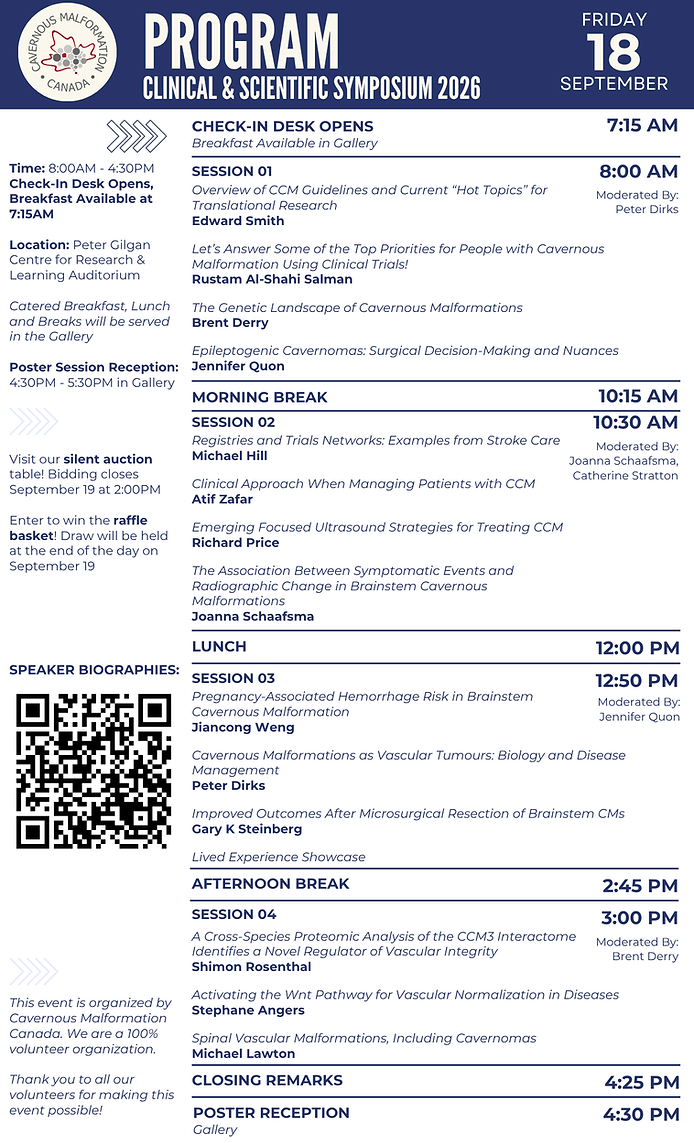
Program Coming Soon
Symposium Hours:
Friday, September 18 2026: 0800h to 1600h (Registration Desk opens and breakfast service starts at 0700h)
Saturday, September 19 2026: 0800h to 1500h
Confirmed Speakers:
Dr. Atif Zafar
Dr. Atif Zafar obtained his Bachelor of Medicine, Bachelor of Surgery (MBBS) from Dow Medical College and completed his residency at the University of Iowa Hospital and Clinics. He also completed a Vascular Neurology Fellowship at the Cleveland Clinic. Upon completing his fellowship, Dr. Zafar became an Assistant Professor of Stroke and Vascular Neurology at the University of New Mexico School of Medicine, then moved to the position of Chief of the Stroke Program at University of New Mexico School of Medicine.
Dr. Zafar was the Assistant Professor of Medicine, Division of Neurology at the University of Toronto, the Co-Director of the Fellowship Program-Stroke at St. Michael's Hospital and the Medical Director of St. Michael's Hospital Comprehensive Stroke Program until June 2025. Currently, he is the Neurology Attending and Tele-Neurologist in Dallas, Texas for Tele-Specialists USA.
Dr. Zafar's clinical focus is on complex stroke cases and cerebrovascular diseases. His academic pursuits involve a personalized stroke algorithm, equitable care access and patient-centered care development. Dr. Zafar has been the PI and co-PI in various United States and Canadian trials, including NIH grants. His collaborative work has been published in Stroke, Lancet, New England Journal of Medicine, JAMA Neurology, and Nature Communications.
Dr. W Brent Derry
Dr. Derry earned his B.Sc. (Honours) in Biochemistry at Carleton University in Ottawa, his M.Sc. in Biochemistry at McMaster University and his Ph.D in Biochemistry and Molecular Biology at the University of California, Santa Barbara (UCSB). He completed his postdoctoral fellowship with Dr. Joel Rothman at UCSB, where he discovered and characterized the long sought after C. elegans p53 tumour suppressor gene cep-1. Dr. Derry joined the SickKids Research Institute in 2003 and uses C. elegans and human cells to model human diseases such as cerebral cavernous malformation (CCM). Dr. Derry holds a Tier 1 Canada Research Chair in Animal Models of Human Disease. He is a Senior Scientist in the Developmental and Stem Cell Biology Program at SickKids and a Full Professor in the Department of Molecular Genetics at the University of Toronto. His research is supported by funding from CIHR, NSERC, CFI and SickKids.
Dr. Derry previously served as Vice-Chair of Fundamental Research in the Garron Family Cancer Centre and is currently the Research Integrity Advisor at SickKids. He is Chair of the Scientific Advisory Board for Alliance to Cure Cavernous Malformation. Dr. Derry is also an editor with the FEBS Journal and an Affiliate for the pre-print server bioRxiv.
Outside of science, Dr. Derry enjoys walking his dog, playing hockey as well as writing and performing original music.
Dr. Peter Dirks
Dr. Peter Dirks is a Professor of Surgery and Molecular Genetics at the University of Toronto. He holds a Harold Hoffman/Shopper Drug Mart Chair in Pediatric Neurosurgery at the Hospital for Sick Children as Division Head. He is a Senior Scientist in the Developmental, Stem Cell and Cancer Biology Program. He is a Fellow of the Royal Society of Canada.
Dr. Dirks received his MD from Queen's University (1989) followed by a PhD at the University of Toronto (1997). He completed neurosurgery training at the University of Toronto (1998) and a pediatric neurosurgery fellowship at Necker Enfants Malades in Paris (1998) Dr. Dirks joined the neurosurgery staff at SickKids in 1998, developing a clinical focus in surgical neuro-oncology and neurovascular disorders.
In 1999, he established his research laboratory in the Arthur and Sonia Labatt Brain Tumour Research Centre at SickKids where in 2004 he was the first to prospectively identify cancer stem cells in human brain tumours, contributing to a paradigm shift in understanding solid cancer growth, and putting emphasis on stemness properties and tissue development both experimentally and conceptually in the study of primary brain tumours.
His research interests continue to lie with the intersection of cancer biology with stem cell and developmental biology, with a focus on uncovering the origins and mechanisms of growth and evolution of glioblastoma and medulloblastoma. He has published nearly 250 papers with 57,000 citations and an h-index of 95. Over his career he has directly mentored over 23 graduate students and 14 postdoctoral fellows.
Dr. Jennifer Quon
Dr. Jennifer Quon is a paediatric neurosurgeon at The Hospital for Sick Children and an Assistant Professor in the Department of Surgery at the University of Toronto. She is also an Associate Scientist-Track Investigator in the Neurosciences and Mental Health program at the SickKids Research Institute.
Dr. Quon has broad clinical interests in paediatric neurosurgery including the surgical treatment of brain tumours, particularly through endoscopic endonasal approaches, as well as vascular disorders in children. Her research interests include machine learning applications in medical imaging and paediatric neurosurgical diseases.
Dr. Miguel Lopez-Ramirez
Dr. Lopez-Ramirez is an Associate Professor at the UC San Diego (UCSD) School of Medicine. He holds degrees in Pharmaceutical Science and Molecular and Cellular Neurobiology. As a Neurovascular Biologist, Dr. Lopez-Ramirez researches the cellular, molecular, epigenetic, and genetic mechanisms underlying the pathological and physiological roles of vascular abnormalities and neuroinflammation. His laboratory at UCSD studies cerebral cavernous malformation disease within a multidisciplinary and highly collaborative environment, working alongside colleagues in fields ranging from clinical medicine to structural, behavioural, pharmacological, and molecular biology.
Dr. Ashkan Shoamanesh
Dr. Ashkan Shoamanesh is an Associate Professor of Medicine (Division of Neurology) and a stroke neurologist at McMaster University, where he holds the Marta and Owen Boris Chair in Stroke Research and Care. He is the founding Director of the Hemorrhagic Stroke Research Program and a Senior Scientist at the Population Health Research Institute. He obtained his medical doctorate from McMaster University (2007), and completed neurology residency training at the University of British Columbia (2012) and clinical/research fellowship training in vascular neurology at Boston University/Framingham Heart Study (2013) and Harvard Medical School (2014).
Shoamanesh’s clinical trials program focuses on advancing treatments and establishing new standards of care to prevent stroke or reduce stroke-related death and disability. He is the principal investigator (PI) or Co-PI of multiple global multicentre randomized trials, including ENRICH-AF (NCT03950076; Lancet 2023), OCEANIC-STROKE (NEJM 2026), SATURN-MRI (NCT03936361), CoVasc-ICH 2 (NCT06587737 ), DO-IT (NCT06571149), LEAST, and INTERCEPT (NCT05723926). He has also held central leadership roles in the ANNEXa-I (NEJM 2024), PACIFIC-STROKE (Lancet 2022), and NAVIGATE-ESUS (NEJM 2018) trials. Shoamanesh is the founding Chair of the Canadian Hemorrhagic Stroke Trials Initiative (CoHESIVE), and was the lead author of the first Canadian Stroke Best Practice Recommendations on the Management of Spontaneous Intracerebral Hemorrhage.
Shoamanesh has published over 200 peer-reviewed manuscripts in top-tier scientific journals. He serves on the editorial boards of Stroke, the International Journal of Stroke, and the Canadian Journal of Neurological Sciences. He is an active contributor to international scientific meetings and previously co-chaired the World Stroke Congress (World Stroke Organization) and the World Intracranial Hemorrhage Conference.
His research program receives funding from several bodies, including the Canadian Institutes of Health Research, National Institutes of Health, Heart and Stroke Foundation of Canada, Brain Canada, Canadian Stroke Consortium, Population Health Research Institute, the Australian Government Medical Research Future Fund, and various industry partners. His contributions have been recognized through numerous prestigious honors from leading Canadian and international organizations, including the American Academy of Neurology (Pessin Award); American Heart/Stroke Association (Globus Award, Siekert Award, Dudley White Award); American Neurological Association (Denny-Brown Award); European Stroke Organization (Young Investigator Award, Scientific Excellence Award); Heart and Stroke Foundation of Canada (National New Investigator Award, Barnett Scholarship); McMaster University (Department of Medicine Mid-Career Research Award); and the World Stroke Organization (Future Leaders Program).
Dr. Ben Goult
Ben Goult is Professor of Mechanistic Cell Biology at the University of Liverpool and studies how cells use mechanical forces to control signaling, adhesion and tissue integrity. His research has helped define how force-sensitive proteins such as talin regulate the actin cytoskeleton and cellular behaviour in health and disease.
His current cavernoma research focuses on how the CCM complex connects to the actin cytoskeleton and vascular mechanics. His group recently identified TLNRD1 as a new interacting partner of CCM2 and is investigating whether TLNRD1 may represent a previously unrecognised fourth CCM gene. He works in collaboration with Alliance to Cure Cavernous Malformation, Cavernoma Alliance UK and The Walton Centre NHS Foundation Trust to help translate discoveries in vascular mechanobiology towards improved understanding and treatment of cavernous malformations.
Dr. Rustam Al-Shahi Salman
Rustam is a professor of clinical neurology and head of the cerebrovascular research group at The University of Edinburgh, where he leads the Research to Understand Stroke due to Haemorrhage (RUSH) programme (www.RUSH.ed.ac.uk). RUSH is dedicated to improving the outcome for adults who have diseases that cause stroke due to intracranial haemorrhage using methodologically rigorous clinical epidemiology.
Rustam’s research began in 1998 with prospective population-based inception cohort studies in Scotland and now focuses on international randomised controlled trials and individual participant data meta-analyses, which has led him to being the clinical director of the UK Registered Clinical Trials Unit Network. His work on cavernoma includes contributions to: the CARE pilot trial (ISRCTN41647111), Treat_CCM trial, NCT03589014, and forthcoming CARE-Aspirin trial; 23 original research publications; the definition of haemorrhage; international clinical guidelines; patient information; Patron of Cavernoma Alliance UK; Scientific and Medical Adviser to Cavernoma Alliance UK; and being a Member of the Scientific Advisory Board, Alliance to Cure Cavernous Malformation, USA. Rustam is also an honorary consultant neurologist in NHS Lothian, where his clinical work includes acute TIA/stroke/neurology services and specialist outpatient clinics. See www.whopaysthisdoctor.org/doctor/276/active for disclosures.
...and more to come!
CMC Clinical & Scientific Symposium
Where Peter Gilgan Centre for Research and Learning (686 Bay Street, Toronto ON M5G 0A4)
When September 18, 2026 8AM-4PM
September 19, 2026 8AM-3PM
Registration Fee Early Bird $199.00 CAD (until June 1)
Need Help? Email us at contactus@cavernousmalformation.ca
Cavernous Malformation Canada
Charitable Registration #851604041 RR 0001
