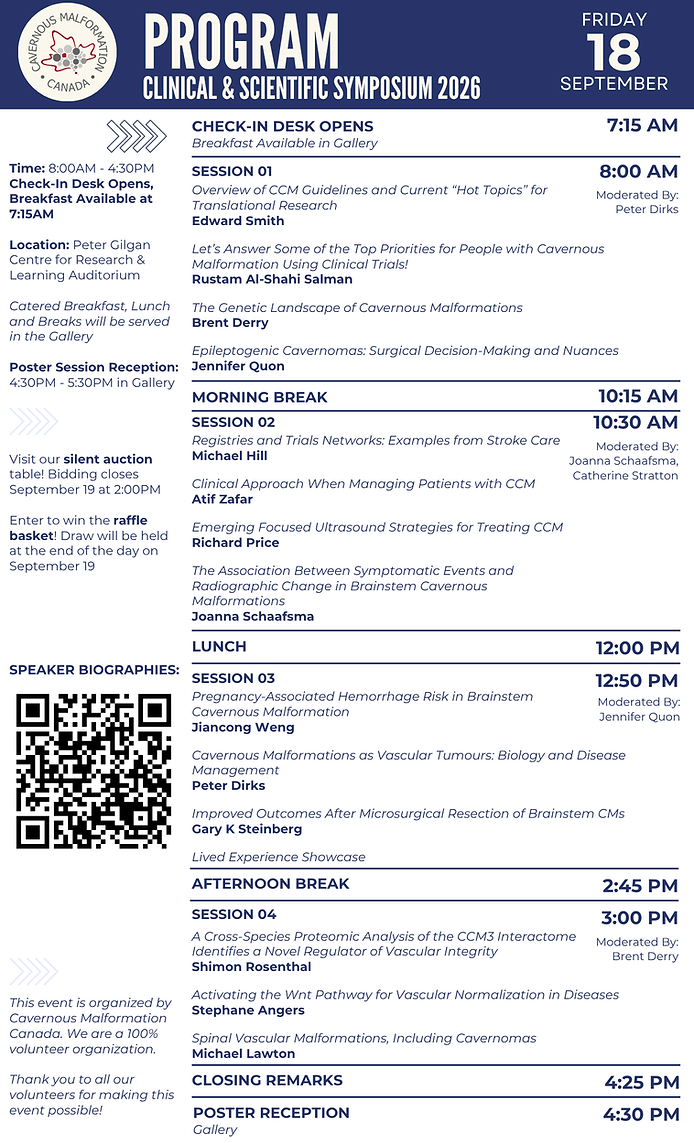
CMC Clinical & Scientific Symposium Draft Program
Last Updated: August 20, 2026


Confirmed Speakers:
Dr. Atif Zafar
Dr. Atif Zafar obtained his Bachelor of Medicine, Bachelor of Surgery (MBBS) from Dow Medical College and completed his residency at the University of Iowa Hospital and Clinics. He also completed a Vascular Neurology Fellowship at the Cleveland Clinic. Upon completing his fellowship, Dr. Zafar became an Assistant Professor of Stroke and Vascular Neurology at the University of New Mexico School of Medicine, then moved to the position of Chief of the Stroke Program at University of New Mexico School of Medicine.
Dr. Zafar was the Assistant Professor of Medicine, Division of Neurology at the University of Toronto, the Co-Director of the Fellowship Program-Stroke at St. Michael's Hospital and the Medical Director of St. Michael's Hospital Comprehensive Stroke Program until June 2025. Currently, he is the Neurology Attending and Tele-Neurologist in Dallas, Texas for Tele-Specialists USA.
Dr. Zafar's clinical focus is on complex stroke cases and cerebrovascular diseases. His academic pursuits involve a personalized stroke algorithm, equitable care access and patient-centered care development. Dr. Zafar has been the PI and co-PI in various United States and Canadian trials, including NIH grants. His collaborative work has been published in Stroke, Lancet, New England Journal of Medicine, JAMA Neurology, and Nature Communications.
Dr. W Brent Derry
Dr. Derry earned his B.Sc. (Honours) in Biochemistry at Carleton University in Ottawa, his M.Sc. in Biochemistry at McMaster University and his Ph.D in Biochemistry and Molecular Biology at the University of California, Santa Barbara (UCSB). He completed his postdoctoral fellowship at UCSB where he discovered and characterized the C. elegans TP53 tumour suppressor gene cep-1. Dr. Derry joined the SickKids Research Institute in 2003 and uses C. elegans, human cells, and zebrafish to model human diseases such as neuroblastoma and cerebral cavernous malformation (CCM). Dr. Derry holds a Tier 1 Canada Research Chair in Animal Models of Human Disease. He is a Senior Scientist in the Developmental and Stem Cell Biology Program serves as the Research Integrity Advisor at SickKids. His is a Full Professor in the Department of Molecular Genetics at the University of Toronto and his research is supported by funding from CIHR, NSERC, CFI and CRC.
Dr. Derry chairs the Scientific Advisory Board for Alliance to Cure Cavernous Malformation (USA), is vice chair of the Scientific Advisory Board for Cavernous Malformation Canada, and serves as an editor with the FEBS Journal.
Outside of science, Dr. Derry enjoys walking his dog, playing hockey as well as writing and performing original music.
Dr. Peter Dirks
Dr. Peter Dirks is a Professor of Surgery and Molecular Genetics at the University of Toronto. He holds a Harold Hoffman/Shopper Drug Mart Chair in Pediatric Neurosurgery at the Hospital for Sick Children as Division Head. He is a Senior Scientist in the Developmental, Stem Cell and Cancer Biology Program. He is a Fellow of the Royal Society of Canada.
Dr. Dirks received his MD from Queen's University (1989) followed by a PhD at the University of Toronto (1997). He completed neurosurgery training at the University of Toronto (1998) and a pediatric neurosurgery fellowship at Necker Enfants Malades in Paris (1998) Dr. Dirks joined the neurosurgery staff at SickKids in 1998, developing a clinical focus in surgical neuro-oncology and neurovascular disorders.
In 1999, he established his research laboratory in the Arthur and Sonia Labatt Brain Tumour Research Centre at SickKids where in 2004 he was the first to prospectively identify cancer stem cells in human brain tumours, contributing to a paradigm shift in understanding solid cancer growth, and putting emphasis on stemness properties and tissue development both experimentally and conceptually in the study of primary brain tumours.
His research interests continue to lie with the intersection of cancer biology with stem cell and developmental biology, with a focus on uncovering the origins and mechanisms of growth and evolution of glioblastoma and medulloblastoma. He has published nearly 250 papers with 57,000 citations and an h-index of 95. Over his career he has directly mentored over 23 graduate students and 14 postdoctoral fellows.
Dr. Jennifer Quon
Dr. Jennifer Quon is a paediatric neurosurgeon at The Hospital for Sick Children and an Assistant Professor in the Department of Surgery at the University of Toronto. She is also an Associate Scientist-Track Investigator in the Neurosciences and Mental Health program at the SickKids Research Institute.
Dr. Quon has broad clinical interests in paediatric neurosurgery including the surgical treatment of brain tumours, particularly through endoscopic endonasal approaches, as well as vascular disorders in children. Her research interests include machine learning applications in medical imaging and paediatric neurosurgical diseases.
Dr. Edward Smith
Dr. Edward Smith is a principal investigator in the Vascular Biology Program, professor at Harvard Medical School and the R. Michael Scott endowed chair in neurosurgery at Boston Children's Hospital, with degrees from Dartmouth, Columbia, Harvard and the Massachusetts Institute of Technology. He is the Vice-chair and Chief of Operations (COO) of the top ranked department of pediatric neurosurgery in the United States and, together with Darren Orbach, leads the Cerebrovascular Surgery and Interventions Center, which sees one of the highest volumes of complex pediatric cerebrovascular disease in North America.
His research on cerebrovascular disease and brain tumors focuses on non-invasive biomarkers and novel therapeutics. He has published textbooks, >300 peer-reviewed and invited articles and >100 chapters. His laboratory in the Vascular Biology Program has been supported by NIH and foundation funding and reported the first-ever use of non-invasive urinary biomarkers in brain tumors. He has let multi-center clinical trials on brain tumor and stroke, innovated novel surgical approaches, partnered with industry on development of targeted therapeutics and had his work incorporated into the 2009, 2019 and 2025 national guidelines for the Angioma Alliance and the American Heart and Stroke Associations.
Dr. Smith was a founder of the Boston-London-Toronto Cerebrovascular Consortium, currently serves as the national medical director of the Coalition to Cure Cavernous Malformations in the US and is a member of the Board of Directors for the International Pediatric Stroke Organization. He has been recognized for his teaching and mentoring, including co-leading the first pediatric cerebrovascular fellowship in the United States and receiving the R. Michael Scott Mentoring Award.
Dr. Michael Lawton
Michael T. Lawton, MD, is the president and chief executive officer of Barrow Neurological Institute, as well as its chairman of the Department of Neurological Surgery and the Robert F. Spetzler Endowed Chair in Neurosciences. Additionally, he is the chief of vascular and skull base neurosurgery at Barrow. He specializes in the surgical treatment of aneurysms, arteriovenous malformations, arteriovenous fistulas, cavernous malformations, and cerebral revascularization, including carotid endarterectomy. As the leader of the largest cerebrovascular center in the country, he has experience in surgically treating more than 5,400 brain aneurysms and over 1200 AVMs. He also practices skull base tumor surgery and is trained in the endovascular treatment of aneurysms.
Dr. Lawton co-directs and conducts his research at the Barrow Aneurysm and AVM Research Center (BAARC), a collaborative research group funded by grants from the National Institutes of Health that investigates the physiology of cerebral circulation and the pathophysiology of vascular malformations. His basic science investigations focus on the formation, underlying genetics, and rupture of brain AFVMs, as well as the hemodynamics, rupture, and computational modeling of brain aneurysms. His clinical investigations study the anatomy of microsurgical approaches to vascular lesions and the outcomes of aneurysm, AVM, and bypass surgery. He is the principal investigator of a NIH U54 grant and program director of the Brain Vascular Malformation Consortium (BVMC), a multicenter group studying malformations associated with hereditary hemorrhagic telangiectasia, cavernous malformations, and Sturge-Weber syndrome.
He has published over 1,000 peer-reviewed articles, over 100 book chapters, and eight textbooks, including Seven AVMs: Tenets and Techniques for Resection, Seven Bypasses: Tenets and Techniques for Revascularization, and Seven Aneurysms: Tenets and Techniques for Clipping, which has won numerous awards and sold more copies than Yasargil’s Microneurosurgery. He recently published the fourth book in the Seven tetralogy, Seven Cavernomas: Tenets and Techniques for Resection. Dr. Lawton’s accolades include the Young Neurosurgeon Award from the World Federation of Neurological Societies, the Harold Rosegay Teaching Award, the Diane Ralston Clinical and Basic Science Teaching Award, BNI Neurosurgery Teaching Awards, an Impact Award as Exceptional Innovator from the Greater Phoenix Chamber, the Dacey Medal for outstanding cerebrovascular research, and the Cushing Award for Technical Excellence and Innovation from the American Association of Neurological Surgeons. He has given over 1200 invited lectures nationally and internationally, including visiting professorships at over 60 neurosurgical institutions. He has been active in resident teaching, directing the CNS Anatomy Course for Senior Residents, co-directing the AANS Vascular Skills Course, and directing industry-sponsored anatomy courses. He sponsors an observership in vascular neurosurgery that has hosted more the 600 neurosurgeons and residents nationally and internationally. He co-founded Mission:BRAIN, a teaching mission to raise the level of neurosurgery practiced in developing countries, and has conducted eight missions in Mexico, the Philippines, and Peru.
Dr. Miguel Lopez-Ramirez
Dr. Lopez-Ramirez is an Associate Professor at the UC San Diego (UCSD) School of Medicine. He holds degrees in Pharmaceutical Science and Molecular and Cellular Neurobiology. As a Neurovascular Biologist, Dr. Lopez-Ramirez researches the cellular, molecular, epigenetic, and genetic mechanisms underlying the pathological and physiological roles of vascular abnormalities and neuroinflammation. His laboratory at UCSD studies cerebral cavernous malformation disease within a multidisciplinary and highly collaborative environment, working alongside colleagues in fields ranging from clinical medicine to structural, behavioural, pharmacological, and molecular biology.
Dr. Gary K Steinberg
Gary K. Steinberg was born in Brooklyn, New York and was raised in Westchester County, New York. He graduated summa cum laude with Honors in Biology from Yale University, where he was elected to Phi Beta Kappa. Before attending medical school he studied classical trumpet on a music study scholarship at the Institute for Advanced Musical Studies in Montreux, Switzerland. He was accepted into the Medical Scientist Training Program at Stanford University School of Medicine and graduated with an M.D. and a Ph.D. in Neurosciences in 1980. He completed his surgical internship and residency in Neurological Surgery at Stanford under John Hanbery. During his training he received an NIH NINDS Individual National Research Service Award to investigate aneurysmal subarachnoid hemorrhage, and he spent one year studying cerebrovascular surgery with Charles Drake in London, Ontario.
In 1987 Dr. Steinberg joined the faculty at Stanford as Assistant Professor in Neurosurgery, being promoted to associate professor with tenure in 1993 and professor in 1997. He founded the Stanford Stroke Center in 1991 and is currently the Co-Director, and is Founder and Director of the Stanford Moyamoya Center. He served as Chair of the Department of Neurosurgery at Stanford from 1995-2020 and holds the Bernard and Ronni Lacroute-William Randolph Hearst Endowed Chair of Neurosurgery and the Neurosciences. Over the past 25 years Dr. Steinberg expanded the department from a faculty of 5 to more than 60 neurosurgeons and scientists.
Dr. Steinberg maintains a busy clinical practice specializing in cerebrovascular surgery. His clinical research is focused on developing innovative surgical, endovascular and radiosurgical approaches for treating patients with difficult intracranial aneurysms, complex vascular malformations and occlusive cerebrovascular disorders including moyamoya disease. He has also spearheaded several early phase clinical trials of stem cell transplantation for chronic stroke and subacute spinal cord injury. Dr. Steinberg's lab investigates pathomechanisms of cerebral ischemia, develops neuroprotective agents, and employs novel approaches such as stem cell transplantation and optogenetic stimulation to enhance post-stroke functional recovery. Dr. Steinberg is heavily involved in teaching, serving as Neurosurgery Program Director from 1995-2004 and training more than 180 residents, clinical fellows, post-doctoral research fellows, graduate students and medical students. He has published over 425 peer reviewed articles, more than 135 book and video chapters, and edited 5 books primarily related to clinical and basic aspects of cerebrovascular disease. He has received grants as Principal Investigator from the AANS NREF, American Heart Association, California Institute for Regenerative Medicine and has held continuous NIH funding since 1987, including R01 and P01 Grants.
The many honors Dr. Steinberg has received include an AANS Young Faculty Award; Santa Clara County Medical Association Outstanding Achievement in Medicine Award; President of the Western Neurosurgical Society; 2016 Congress of Neurological Surgeons Annual Meeting Charles Drake Lecturer; Stanford University Medicine Alumni Association J.E. Wallace Sterling Lifetime Achievement Award in Medicine; American Heart Association/American Stroke Association Stroke Progress and Innovation Award; Society of Neurological Surgeons H. Richard Winn, M.D. Prize; Smithsonian American Ingenuity Award; American Association of Neurological Surgeons/Congress of Neurological Surgeons Joint Cerebrovascular Section, Ralph G. Dacey, Jr., M.D. Medal for Outstanding Cerebrovascular Research and California Association of Neurological Surgeons, Byron Cone Pevehouse Distinguished Service Award. Dr. Steinberg has been Visiting Professor at numerous academic institutions internationally and given more than 600 invited talks at scientific meetings throughout the world. He has been a member of NIH NINDS Study Sections, the NIH NASCET Monitoring Committee, and served on the editorial boards of the Journal of Cerebral Blood Flow and Metabolism, Neurosurgery, Cerebrovascular Diseases, the Journal of Stroke and Cerebrovascular Diseases, Indian Journal of Neurosurgery and World Neurosurgery.
Dr. Steinberg is married to Sandra Garritano. His son Jeff is a cerebrovascular neurosurgeon and his daughter Liz is a child psychologist.
Dr. Ben Goult
Ben Goult is Professor of Mechanistic Cell Biology at the University of Liverpool and studies how cells use mechanical forces to control signaling, adhesion and tissue integrity. His research has helped define how force-sensitive proteins such as talin regulate the actin cytoskeleton and cellular behaviour in health and disease.
His current cavernoma research focuses on how the CCM complex connects to the actin cytoskeleton and vascular mechanics. His group recently identified TLNRD1 as a new interacting partner of CCM2 and is investigating whether TLNRD1 may represent a previously unrecognised fourth CCM gene. He works in collaboration with Alliance to Cure Cavernous Malformation, Cavernoma Alliance UK and The Walton Centre NHS Foundation Trust to help translate discoveries in vascular mechanobiology towards improved understanding and treatment of cavernous malformations.
Dr. Rustam Al-Shahi Salman
Rustam is a professor of clinical neurology and head of the cerebrovascular research group at The University of Edinburgh, where he leads the Research to Understand Stroke due to Haemorrhage (RUSH) programme (www.RUSH.ed.ac.uk). RUSH is dedicated to improving the outcome for adults who have diseases that cause stroke due to intracranial haemorrhage using methodologically rigorous clinical epidemiology.
Rustam’s research began in 1998 with prospective population-based inception cohort studies in Scotland and now focuses on international randomised controlled trials and individual participant data meta-analyses, which has led him to being the clinical director of the UK Registered Clinical Trials Unit Network. His work on cavernoma includes contributions to: the CARE pilot trial (ISRCTN41647111), Treat_CCM trial, NCT03589014, and forthcoming CARE-Aspirin trial; 23 original research publications; the definition of haemorrhage; international clinical guidelines; patient information; Patron of Cavernoma Alliance UK; Scientific and Medical Adviser to Cavernoma Alliance UK; and being a Member of the Scientific Advisory Board, Alliance to Cure Cavernous Malformation, USA. Rustam is also an honorary consultant neurologist in NHS Lothian, where his clinical work includes acute TIA/stroke/neurology services and specialist outpatient clinics. See www.whopaysthisdoctor.org/doctor/276/active for disclosures.
Dr. Miguel A. Lopez-Toledano
Dr. Miguel A. Lopez-Toledano is the Medical Director of Clinical Development & Medical Affairs at Neurelis, Inc. and Affiliated Assistant Professor at the Florida Atlantic University.
With a PhD in Neuroscience from the Complutense University of Madrid, Dr. Lopez-Toledano's expertise is in cross-functional strategy, clinical trial support, evidence generation, regulatory alignment, and scientific communication. Over his 30+ year career he has been involved in clinical development, medical affairs, neuroscience research, and project leadership across biotechnology and pharma.
Dr. Richard Price
Richard J. Price, PhD, is Professor of Radiology & Medical Imaging and Biomedical Engineering at the University of Virginia (UVa). He is also Co-Director of the UVa Focused Ultrasound Cancer Immunotherapy Center and Co-Leader of the UVa Comprehensive Cancer Center’s Therapeutics (CRX) Program. He has been studying ultrasound-targeted drug and gene delivery for ~25 years, and his research program has been supported continuously by NIH R01 funding since 1998. He was amongst the first investigators to observe that interactions between contrast agent microbubbles and ultrasound can be used to open endothelial barriers for targeted nanoparticle delivery, with emphasis on delivery across the blood-brain barrier. Recent studies entail using this approach to treat infiltrative gliomas and brain metastases, as well as for reversing neurodegeneration and stabilizing cerebral cavernous malformations.
Dr. Price is also studying how focused ultrasound can synergize with various immunotherapeutic approaches, with his research in this area supporting clinical trials at UVa combining focused ultrasound with chemo- and immunotherapy for multiple cancer indications. Dr. Price has received the Andrew J. Lockhart Memorial Award for Focused Ultrasound Cancer Research, the Jorge Heller Award for Outstanding Original Research Paper in the Journal of Controlled Release, and the Gerritsen Award for most highly cited review article from the Microcirculatory Society. He is a Fellow of the American Institute of Medical and Biological Engineering and the Controlled Release Society and has been named to the Council of Distinguished Investigators for the Academy of Radiology & Biomedical Imaging Research. He has also served on both the Executive Council of the Microcirculatory Society and the International Society for Therapeutic Ultrasound (ISTU) Board of Directors.
Dr. Peetra Magnusson
Dr. Peetra Magnusson is Associate Professor and Principal Investigator of the Department of Immunology, Genetic and Pathology, Vascular Biology, at Uppsala University in Sweden. She is also the Director of the Data Driven Life Science Research School (SciLifeLab). She earned her Master of Science in Pharmacy, Pharmacist certification in 2000, and PhD in 2005 at Genetics and Pathology, Uppsala University. She was the Director of the Rudbeck Laboratory from 2020 to 2026.
Dr. Magnusson’s research is focused on immunothrombosis specifically in cerebral cavernous malformations, and vascular protection foscuing on pre-clinical analysis and pharmaceutical targets. She has an h-index of 30 and has authored and co-authored >50 peer reviewed articles with over 2600 citations (WOS). Since 2021 Dr. Magnusson is also engaged in the patient advocacy organization Cavernöst Angiom Sverige (CASE) and is a Scientific Advisory Board Member in both Alliance to Cure Cavernous Malformation (USA) and Cavernoma Alliance UK.
Dr. Jiancong Weng
Jiancong Weng, MD, PhD, earned his doctorate from Beijing Tiantan Hospital under the mentorship of Professors Junting Zhang and Yong Cao. He is an Attending Neurosurgeon in the Department of Neurosurgery, China-Japan Friendship Hospital, and has long been dedicated to the clinical management and basic research of cerebrovascular diseases. He has led several research projects, including the National Natural Science Foundation of China Young Scientists Fund, the Beijing Young Elite Scientist Sponsorship Program, and the China-Japan Friendship Hospital Elite Program ("Qingmiao" and "Backbone Talent"). In recent years, he has published more than 20 SCI-indexed papers as first author, with major representative publications in The American Journal of Human Genetics, Neurology, Stroke, BRAIN, and JNNP.
Dr. Alexandre Dubrac
Alexandre Dubrac, PhD is an Associate Professor in the Department of Pathology and Cell Biology at the Université de Montréal and Principal Investigator at the CHU Sainte-Justine Research Center. His laboratory investigates how the neurovascular system develops and how disruptions of endothelial signaling lead to cerebrovascular diseases, with a particular focus on brain arteriovenous malformations and blood-brain barrier dysfunction. By combining mouse genetics, advanced imaging, and single-cell and spatial genomics, his research has helped define the dynamic landscape of vascular endothelial heterogeneity during CNS development and uncover mechanisms driving cerebral vascular malformations, providing new opportunities for therapeutic intervention.
Dr. Jason Fish
Dr. Jason Fish completed his PhD at the University of Toronto under the supervision of Dr. Philip Marsden. Here he uncovered a role for epigenetics in gene regulation in blood vessels. This was followed by a postdoctoral fellowship at the Gladstone Institute of Cardiovascular Disease and the University of California San Francisco under the supervision of Dr. Deepak Srivastava. Here, Dr. Fish uncovered a role for microRNAs in regulating the development of the cardiovascular system. Since moving back to Toronto in 2010, Dr. Fish and his team explore the mechanisms of gene regulation in the endothelium in health and disease. His recent work has uncovered how somatic mutations in the endothelium lead to sporadic brain arteriovenous malformations, a leading cause of stroke in young people.
Dr. Joanna Schaafsma
Dr. Joanna Schaafsma is a cerebrovascular neurologist at Toronto Western Hospital, University Health Network, and an Associate Professor at the University of Toronto, Canada. She completed her medical degree and MSc at the University of Groningen in the Netherlands, followed by an internship in vascular neurology in Paris, France, and a PhD combined with neurology residency at Utrecht University in the Netherlands. After a stroke fellowship in Toronto, she joined the faculty of the University of Toronto. Her clinical practice, research, and teaching centre on interdisciplinary decision-making and advanced imaging in cerebrovascular disease. She has a particular interest in vascular anomalies that lead to hemorrhagic stroke, including cavernous malformations and intracranial aneurysms, as well as in hemodynamic stroke.
Dr. Stephane Angers
Dr. Angers is an expert in the field of signal transduction. He obtained his Ph.D from the Université de Montréal in 2002 under the guidance of Dr. Michel Bouvier. His thesis work led to the development and application of light energy transfer methodology for the study of protein-protein interaction and signal transduction. From 2002-2006 he was a Howard Hughes Post-Doctoral Fellow at the University of Washington in Seattle under the supervision of Dr. Randall T. Moon, where he identified and characterized novel components of the Wnt signalling pathway and a new class of E3 ubiquitin ligases.
In October 2006, Dr. Angers established his independent research program in the Department of Pharmaceutical Sciences at the Faculty of Pharmacy and in the Department of Biochemistry at the University of Toronto. He is the recipient of the Canada Research Chair in Functional Architecture of Signal Transduction. His research program is developed to understand the signalling mechanisms underlying the Wnt family of growth factors and their signalling mechanisms in development, adult tissue homeostasis and in human diseases. His pioneer work led to the development of novel antibody molecules blocking and activating the Wnt pathway for the treatment of cancers and regenerative medicine applications. He is the scientific co-founder of AntlerA Therapeutics that was acquired by Roche in the summer of 2024. His work led to the development of Restoret (MK-3000), which came from a molecule developed by AntlerA Therapeutics that was licensed to EyeBio (acquired by Merck in the summer of 2024). MK-3000, a trispecific tetravalent FZD4:LRP5 agonist, is now in Phase 2b/3 clinical trial for the treatment of Diabetes Macular Edema.
In September 2021 Dr. Angers was named Director of the Donnelly Centre of Cellular and Biomolecular Research at the University of Toronto, an internationally recognized Research Institute bringing together multidisciplinary teams of scientists.
CMC Clinical & Scientific Symposium
Where Peter Gilgan Centre for Research and Learning (686 Bay Street, Toronto ON M5G 0A4)
When September 18, 2026 8:00AM-4:15PM
September 19, 2026 8:00AM-3:15PM
Registration Fee Early Bird $199.00 CAD (until Aug 18)
$225.00 CAD
Need Help? Email us at contactus@cavernousmalformation.ca
Cavernous Malformation Canada
Charitable Registration #851604041 RR 0001
